
Free physics lessons · Key formulas · Worked examples
Physics Fundamentals: Learn the Core Laws, Concepts and Formulas of Physics
Physics fundamentals are the core laws and principles that explain how matter, energy, motion and forces behave, from a falling apple to an orbiting satellite. Learn them step by step with labelled diagrams, essential formulas and clear worked examples, completely free.
Classical Mechanics · Kinematics · Thermodynamics · Waves & Optics · Electromagnetism · Modern Physics
6
in-depth branch guides
28
step-by-step worked examples
15
essential formulas with SI units
100%
free, no sign-up
Definition
What Are Physics Fundamentals?
Physics fundamentals are the basic laws, quantities and principles that describe how the physical universe works. They include Newton’s laws of motion, the conservation of energy and momentum, the behaviour of waves, the laws of thermodynamics, electricity and magnetism, and the ideas of modern physics such as relativity and quantum theory.
Every branch of science and engineering is built on these foundations. Chemists use them to explain atomic structure, engineers use them to design bridges, engines and circuits, and astronomers use them to predict the motion of planets. Understanding the fundamentals lets you reason through new problems instead of memorising isolated facts.
The six core branches of physics at a glance
| Branch | What it studies | Key principle | Core equation |
|---|---|---|---|
| Classical Mechanics | Forces, motion and momentum | Newton’s second law | F = ma |
| Kinematics | Describing motion without its causes | Constant-acceleration (SUVAT) equations | v = u + at |
| Thermodynamics | Heat, work and internal energy | First law of thermodynamics | ΔU = Q − W |
| Waves & Optics | Sound, light and oscillations | The wave equation | v = fλ |
| Electromagnetism | Charge, current and fields | Ohm’s law | V = IR |
| Modern Physics | Relativity, quanta and the nucleus | Mass–energy equivalence | E = mc² |
Core concepts
Core Physics Concepts Every Student Should Master
These six ideas appear in almost every physics course and exam. Master them and the rest of physics becomes far easier to follow.
Classical Mechanics
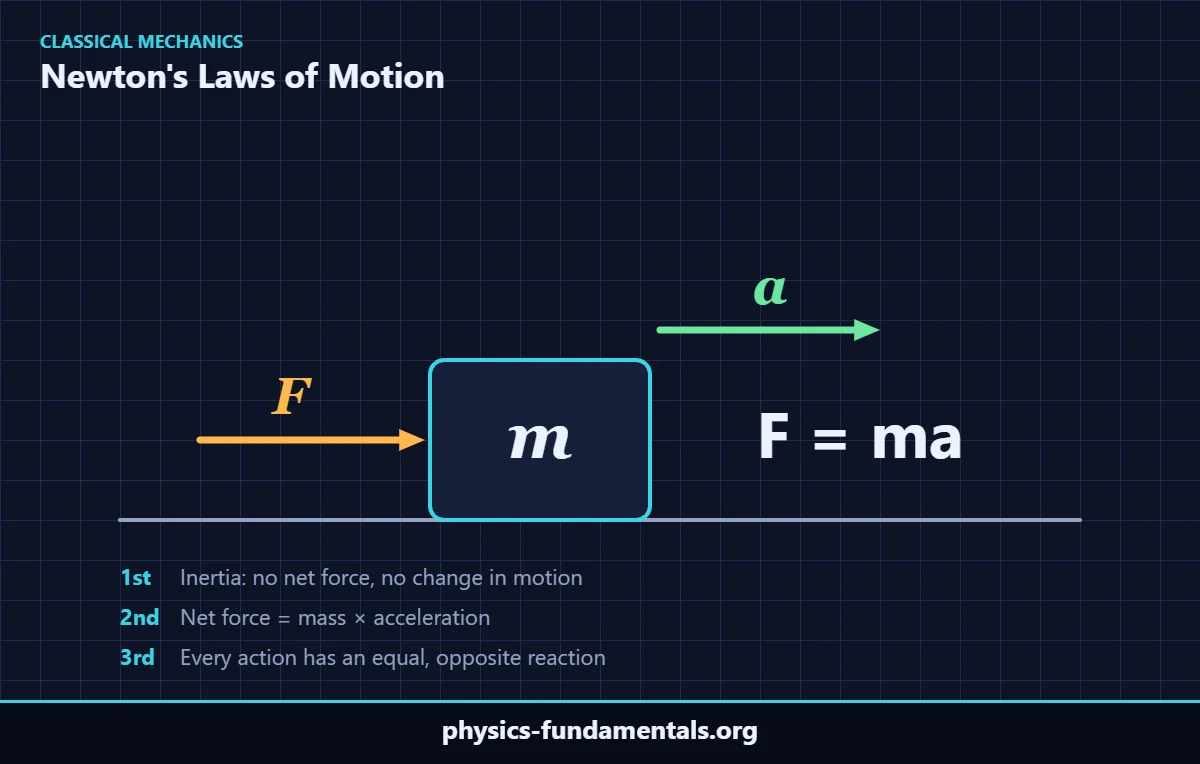
Newton’s Laws of Motion
Newton’s three laws describe how forces change motion. The first defines inertia, the second links net force to acceleration, and the third states that forces always act in equal and opposite pairs. Together they explain everything from a car braking to a rocket launching.
F = ma · force (N) = mass (kg) × acceleration (m/s²)
Waves & Optics
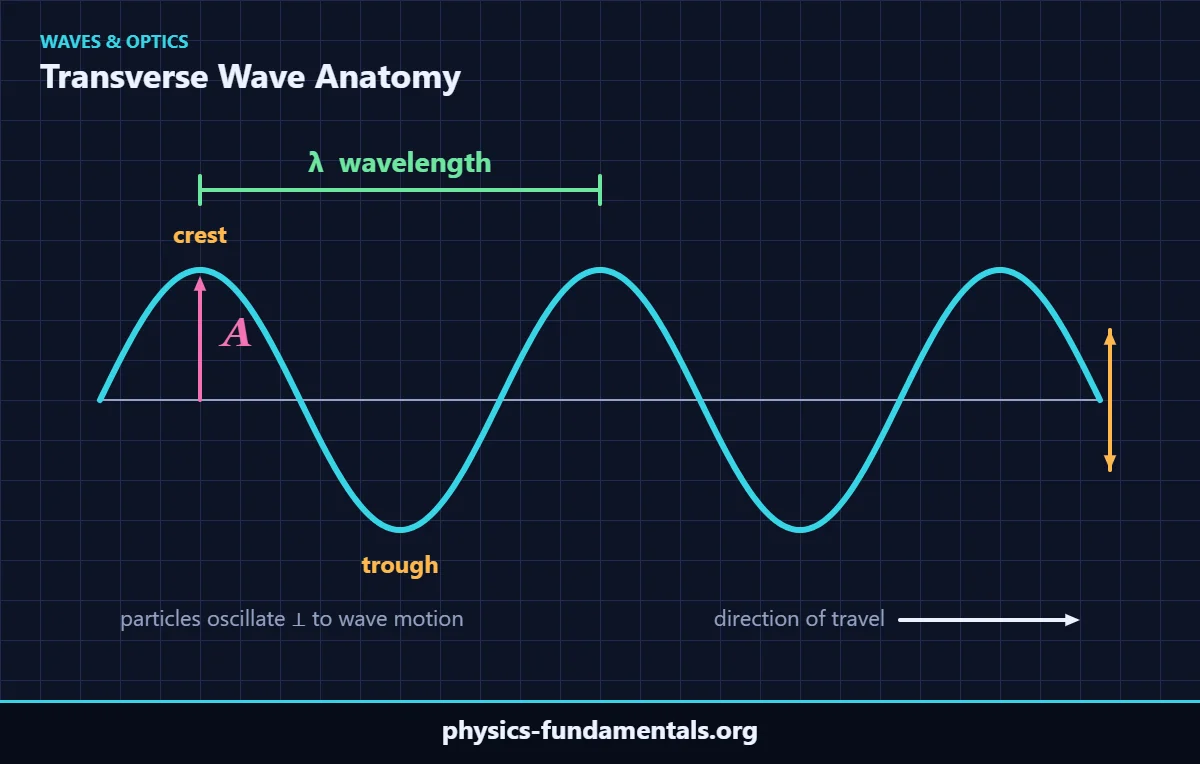
Transverse Waves
In a transverse wave the particles of the medium oscillate at right angles to the direction the energy travels. Light, all electromagnetic waves and waves on a guitar string are transverse. Their key properties are wavelength, amplitude, frequency and period.
T = 1/f · period (s) = 1 ÷ frequency (Hz)
Energy
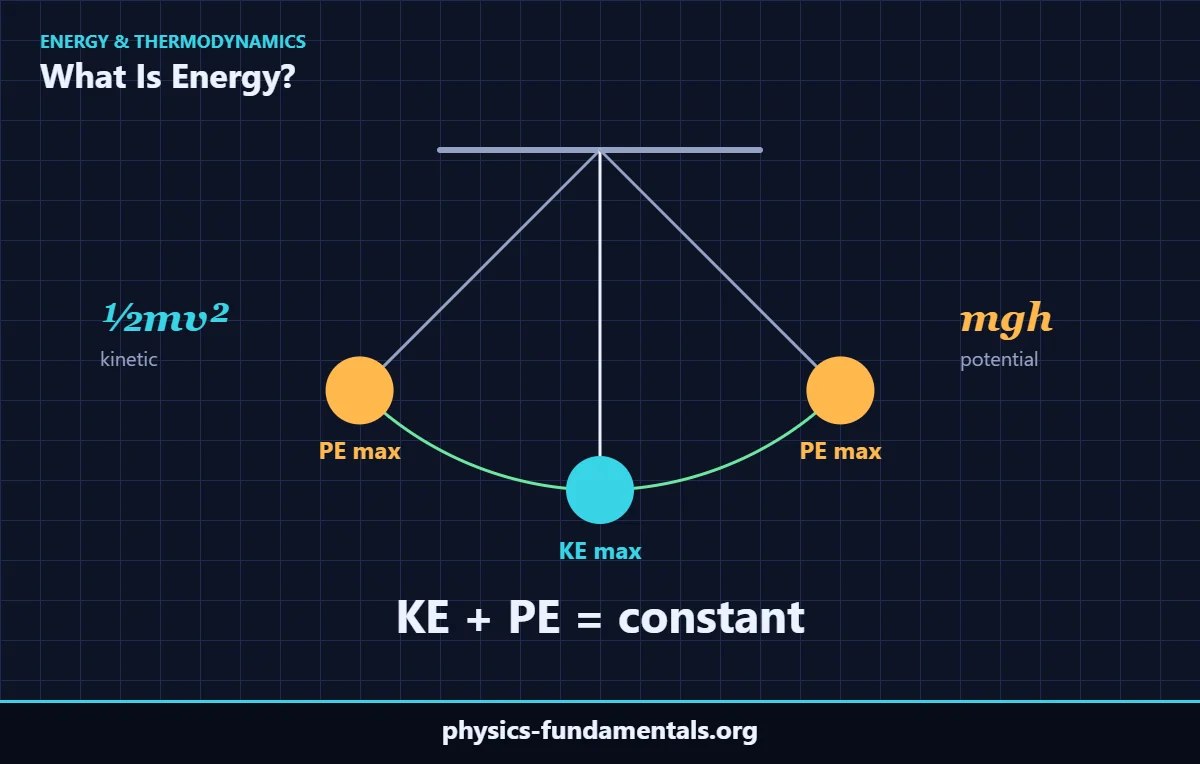
Energy and Its Conservation
Energy is the capacity to do work. It appears as kinetic energy (motion), potential energy (position), thermal energy and more. The law of conservation of energy states that in an isolated system energy is never created or destroyed; it only changes form.
KE = ½mv² · GPE = mgh
Classical Mechanics
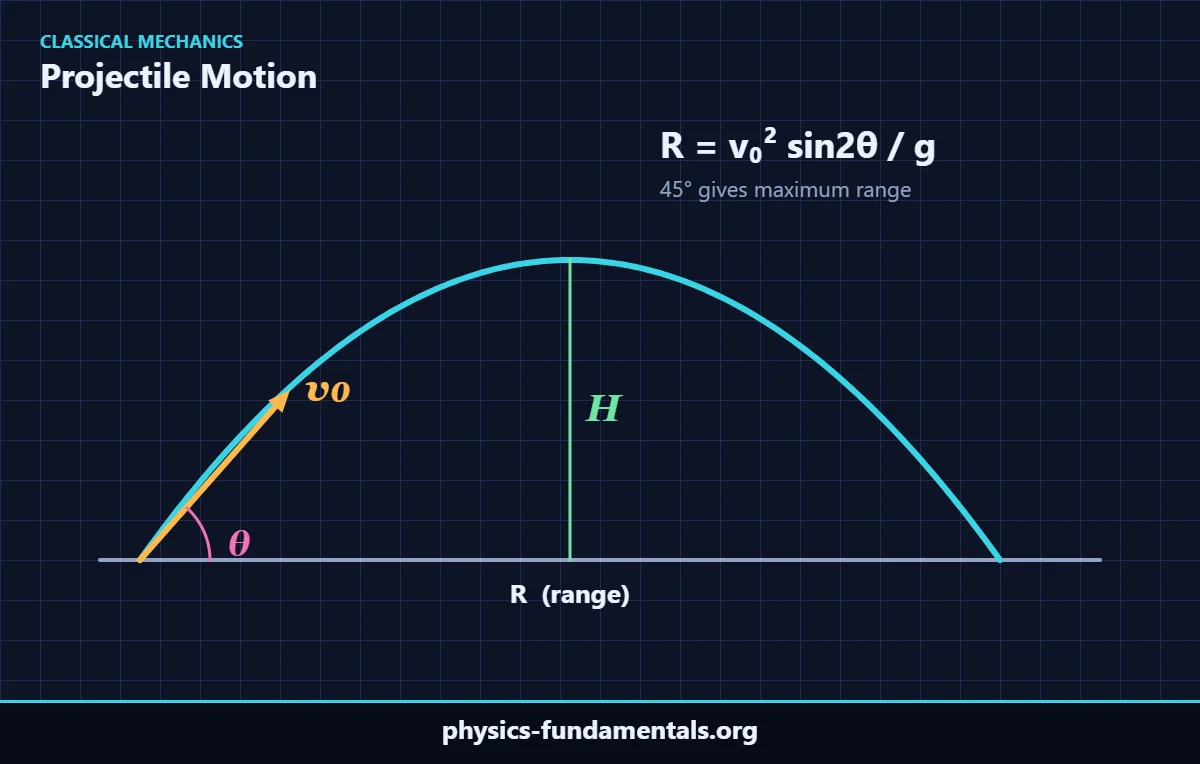
Projectile Motion
A projectile moves horizontally at constant velocity while gravity accelerates it downward, producing a parabolic path. Treating horizontal and vertical motion separately gives the time of flight, maximum height and range. On level ground, a 45° launch gives the greatest range if air resistance is ignored.
R = v₀² sin 2θ / g
Waves & Optics
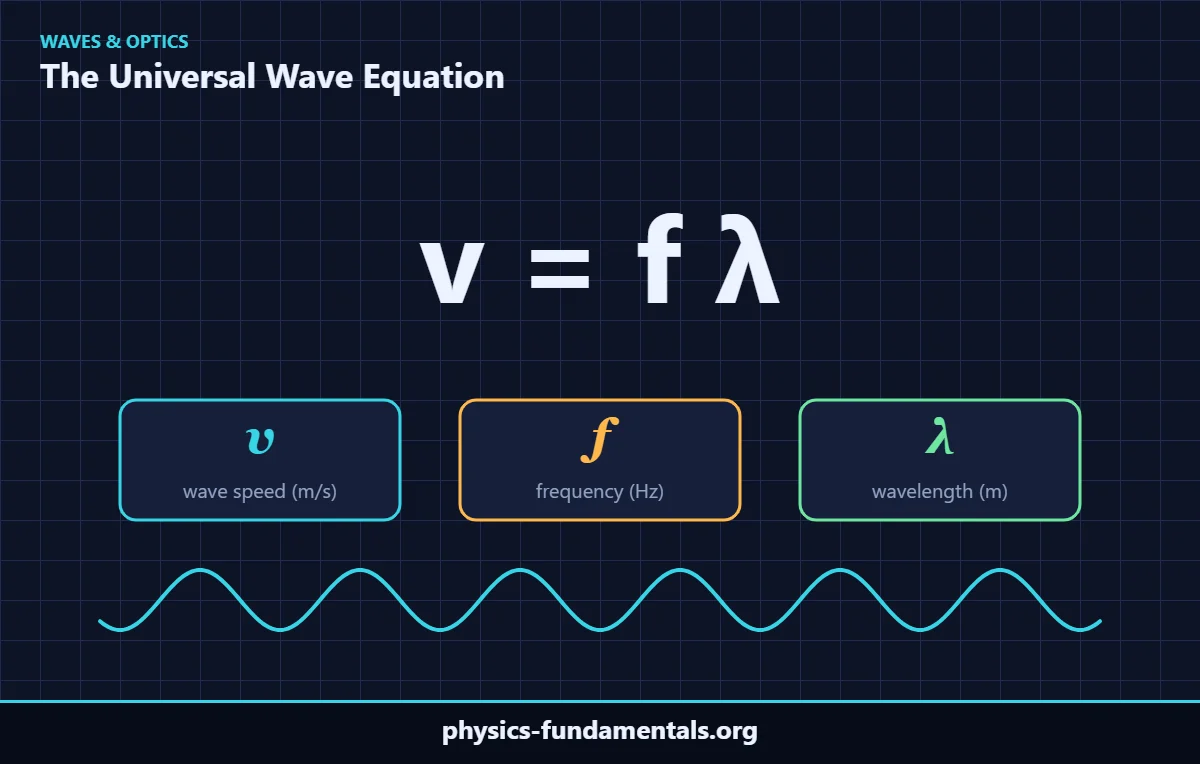
Wave Speed, Frequency and Wavelength
Every wave obeys the same relationship: speed equals frequency multiplied by wavelength. If a sound wave’s frequency doubles in the same medium, its wavelength halves, because the medium sets the speed.
v = fλ · speed (m/s) = frequency (Hz) × wavelength (m)
Classical Mechanics
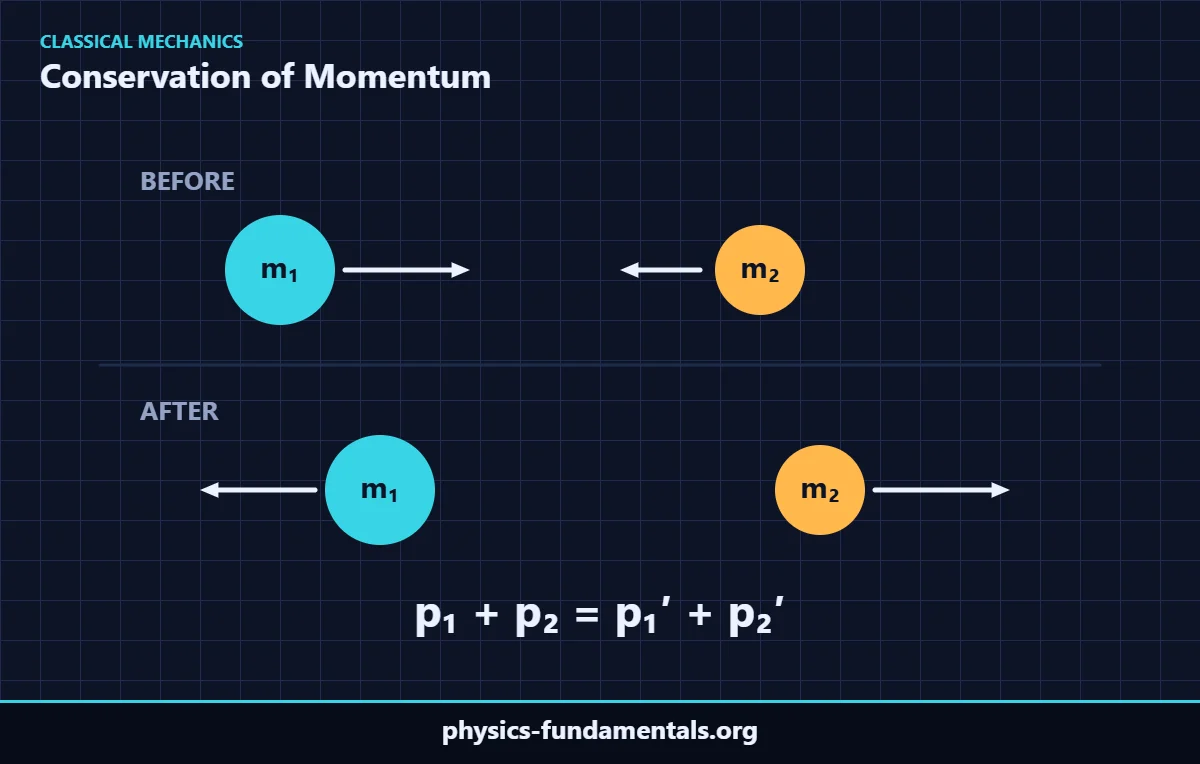
Conservation of Momentum
Momentum is mass multiplied by velocity. In any collision or explosion where no external force acts, the total momentum of the system stays the same. In elastic collisions kinetic energy is also conserved; in inelastic collisions some becomes heat and sound.
p = mv · Σp before = Σp after
Curriculum
Branches of Physics Explained From the Ground Up
Physics is usually taught as six connected branches. Each one reuses the same core ideas of force, energy and fields, so progress in one makes the next easier.
Classical Mechanics
How forces change the motion of everyday objects, from blocks on ramps to planets in orbit.
- Newton’s laws of motion
- Friction, tension and normal force
- Work, energy and power
- Momentum and collisions
- Circular motion and gravitation
Kinematics
The language of motion: displacement, velocity, acceleration and time.
- Speed vs velocity
- Acceleration
- SUVAT equations
- Motion graphs
- Free fall
Thermodynamics
How heat and work move energy between systems.
- Temperature and heat
- Specific heat capacity
- Gas laws and PV = nRT
- Laws of thermodynamics
- Entropy and heat engines
Waves & Optics
How energy travels as oscillations, including sound and light.
- Transverse and longitudinal waves
- Reflection, refraction and Snell’s law
- Interference and diffraction
- The Doppler effect
- Lenses and mirrors
Electromagnetism
Electric charge, current, circuits and magnetic fields.
- Charge and Coulomb’s law
- Current, voltage and resistance
- Series and parallel circuits
- Magnetic fields and forces
- Electromagnetic induction
Modern Physics
Physics at very high speeds and very small scales.
- Special relativity
- The photoelectric effect
- Wave–particle duality
- Atomic models and quantum numbers
- Radioactive decay and half-life
Complete guides
In-Depth Physics Guides for Every Branch
Each guide explains one branch of physics from the basics, with diagrams, key formulas, worked examples and common mistakes to avoid.
- Classical Mechanics Explained: Forces, Motion, Energy and Momentum
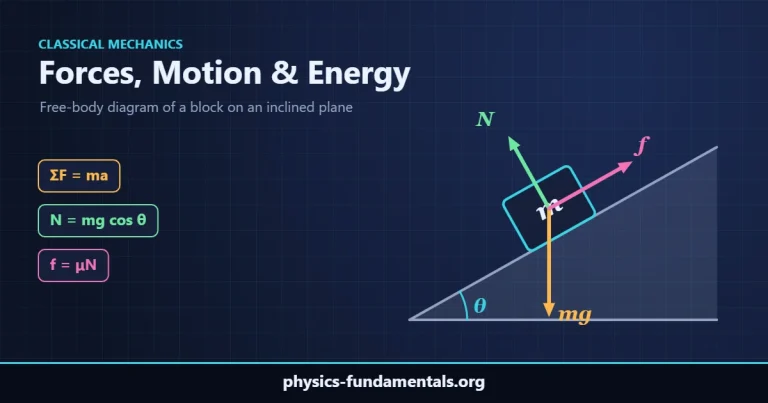 Classical mechanics explained simply: Newton’s laws, types of force, free-body diagrams, work, energy, power, momentum and circular motion with worked examples.
 - Kinematics Explained: Displacement, Velocity, Acceleration and SUVAT
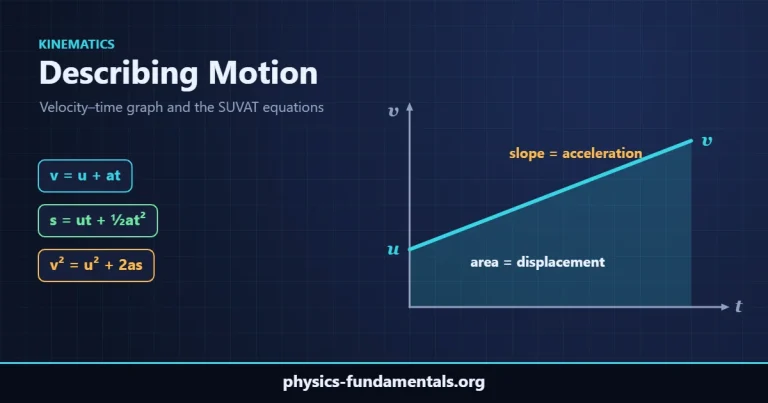 Kinematics made simple: distance vs displacement, speed vs velocity, acceleration, SUVAT equations, motion graphs, free fall and projectiles with examples.
 - Thermodynamics Explained: Heat, Temperature, Gas Laws and the Laws of Thermodynamics
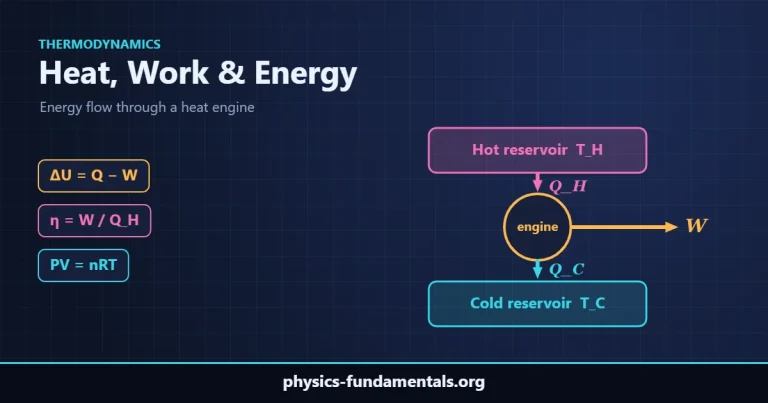 Thermodynamics explained simply: heat vs temperature, specific and latent heat, heat transfer, gas laws, PV = nRT, the laws of thermodynamics and heat engines.
 - Waves and Optics Explained: Wave Properties, Sound, Light and Snell’s Law
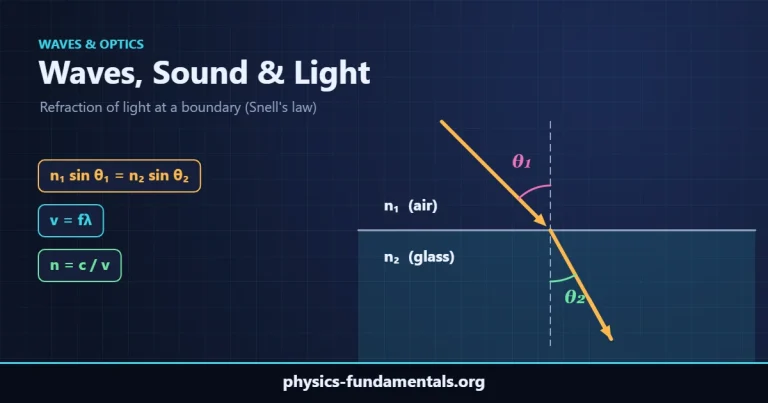 Waves and optics made simple: transverse vs longitudinal waves, v = fλ, sound, the EM spectrum, reflection, refraction, Snell’s law and interference.
 - Electromagnetism Explained: Charge, Current, Circuits and Magnetic Fields
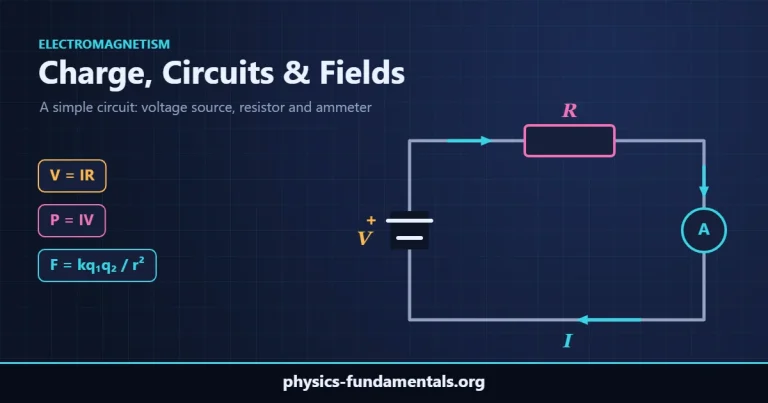 Electromagnetism explained simply: electric charge, Coulomb’s law, current, voltage, Ohm’s law, series and parallel circuits, magnetic fields and induction.
 - Modern Physics Explained: Relativity, Quantum Theory and Nuclear Physics
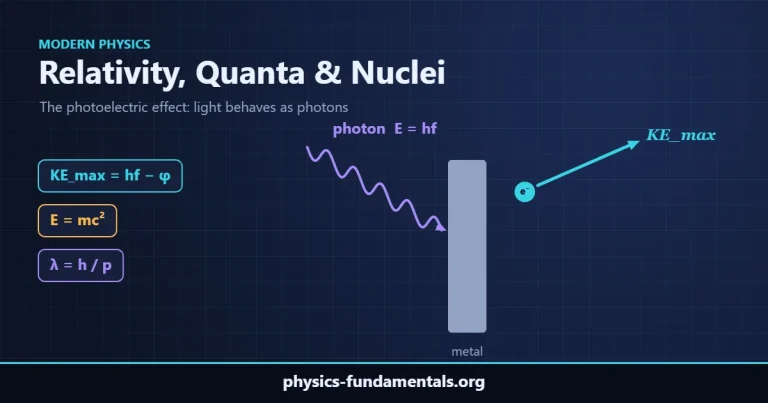 Modern physics explained simply: special relativity, E = mc², photons, the photoelectric effect, wave–particle duality, the Bohr model and half-life.
Study path
How to Learn Physics Fundamentals Step by Step
The fastest way to learn physics is to build each topic on the one before it. Follow this order:
- Learn units and quantities. Know the SI base units and the difference between scalars and vectors.
- Master kinematics. Describe motion with displacement, velocity and acceleration before adding forces.
- Add forces with Newton’s laws. Draw a free-body diagram for every problem.
- Use energy and momentum. Conservation laws solve problems that are hard to tackle with forces alone.
- Move on to waves, heat and electricity. They reuse the same ideas of energy, rates and fields.
- Finish with modern physics. Relativity and quantum theory make sense once classical physics is solid.
- Practise with worked examples. Estimate the answer first, check units, then compare with the solution.
Cheat sheet
Essential Physics Formulas Cheat Sheet
Keep these core equations and their SI units close while you study. Most introductory physics problems use one or more of them.
| Quantity | Formula | SI unit |
|---|---|---|
| Velocity | v = Δs / Δt | m/s |
| Acceleration | a = Δv / Δt | m/s² |
| Force (Newton’s 2nd law) | F = ma | newton (N) |
| Weight | W = mg | newton (N) |
| Momentum | p = mv | kg·m/s |
| Work done | W = Fd cos θ | joule (J) |
| Kinetic energy | KE = ½mv² | joule (J) |
| Gravitational potential energy | GPE = mgh | joule (J) |
| Power | P = W / t | watt (W) |
| Pressure | P = F / A | pascal (Pa) |
| Density | ρ = m / V | kg/m³ |
| Wave speed | v = fλ | m/s |
| Ohm’s law | V = IR | volt (V) |
| Electrical power | P = IV | watt (W) |
| Mass–energy equivalence | E = mc² | joule (J) |
Why us
Why Learn Physics With Physics Fundamentals?
Concept first, then maths
Every topic starts with the physical idea, the “why”, before the equations, so formulas make sense instead of feeling arbitrary.
Step-by-step worked examples
Each solution shows the formula, the substitution with units and the final answer, so you can follow every line.
Clear labelled diagrams
Original diagrams turn forces, waves and fields into pictures you can remember.
Exam friendly
Content lines up with GCSE, A-Level, AP Physics, IB and first-year university courses.
SI units throughout
Consistent units and notation help you avoid the most common exam mistakes.
Free, no sign-up
Every lesson is free to read, with no account and no paywall.
FAQ
Frequently Asked Questions About Physics Fundamentals
What are the fundamentals of physics?
The fundamentals of physics are the core laws and principles that describe how the universe behaves: classical mechanics (Newton’s laws, motion, forces and energy), thermodynamics (heat and entropy), waves and optics (sound and light), electromagnetism (charge, circuits and fields) and modern physics (relativity, quantum theory and nuclear physics).
What is the best way to learn physics fundamentals?
Learn topics in order: units, kinematics, forces, energy and momentum, then waves, heat, electricity and modern physics. Understand the idea behind each law before memorising its equation, work through solved examples, then practise problems on your own. Short daily study sessions work better than cramming.
What are the seven fundamental quantities in physics?
The seven SI base quantities are length (metre, m), mass (kilogram, kg), time (second, s), electric current (ampere, A), thermodynamic temperature (kelvin, K), amount of substance (mole, mol) and luminous intensity (candela, cd). All other units, such as the newton and the joule, are derived from them.
What are Newton’s three laws of motion?
First law: an object stays at rest or moves at constant velocity unless a net force acts on it (inertia). Second law: net force equals mass times acceleration, F = ma. Third law: when one object exerts a force on another, the second exerts an equal and opposite force on the first.
What is the difference between speed and velocity?
Speed is a scalar: it tells you how fast something moves. Velocity is a vector: it tells you how fast and in which direction. A car driving round a roundabout at a steady 30 km/h has constant speed but changing velocity, because its direction keeps changing.
What is the law of conservation of energy?
The law of conservation of energy states that energy cannot be created or destroyed, only transferred or changed from one form to another. In an isolated system the total energy stays constant; for example, a falling object converts gravitational potential energy into kinetic energy.
Is physics hard to learn?
Physics feels hard when formulas are memorised without understanding. Once you grasp a few core ideas, such as forces, energy and waves, most topics follow the same patterns. With diagrams, worked examples and regular practice, anyone can learn the fundamentals.
Start Learning Physics Today
Pick a core concept, study the diagram, then try the formula on a real example. Small steps every day build real understanding.